
 Eximee Team
Digital accessibility in line with WCAG guidelines has ceased to be a side topic and today represents one of the key challenges for the financial sector instead. Implementing the WCAG standard requires not only technological changes but also deep organizational transformation, and banks are increasingly aware of the work needed to meet accessibility requirements, which carries both regulatory and reputational risks.
From standardizing requirements and conducting accessibility audits to raising awareness within institutions, the list of tasks is long. In this context, low-code technology becomes not only a tool for accelerating implementations but a foundation that enables designing and developing applications and documentation in line with accessibility principles from the very first stage of a project all the way to its final delivery.
For financial institutions, implementing WCAG standards is not only a matter of compliance with the EAA directive but also a way to reduce legal risks and avoid potential sanctions. While regulations are the main driver for many banks, digital accessibility is increasingly becoming a strategic area that can also be seen as an opportunity to expand the customer base. According to the Government of the Republic of Poland, there are currently between 4-7 million people with disabilities in Poland. Through digital accessibility, banks gain a real opportunity to reach this group of customers, offering them a full-featured and inclusive banking experience.
On September 6, 2021, the possibility of filing complaints about lack of accessibility was introduced, initially covering only public entities; however, under the European Accessibility Act, from June 28, 2025, this obligation also extends to the private sector, including banks. Under Polish law, failure to meet EAA requirements may result in financial penalties of up to 10% of an institution’s annual turnover.

Legal obligations for banks regarding WCAG (post-2025)
Adapting digital systems to the WCAG standard initially seemed like a mere formality, but in reality, it is a complex process that may appear difficult for many financial institutions to carry out independently. It requires not only knowledge of the guidelines but also an understanding of common mistakes and challenges that arise during implementation.
Low-code technology can play a key role in this process, enabling the standardization of screens and components and forming the foundation for effective WCAG-compliant solutions. Thanks to unified structures, accessibility and security can be ensured at the platform level, while low-code teams can consistently enforce required standards without having to build expert knowledge from scratch.
The Eximee platform supports the design of accessible applications across web and mobile channels. More and more often recently, discussions also include ensuring accessibility in self-service processes and manual tasks performed by bank employees, though at this stage these are directions for future development rather than implemented solutions. In this way, Eximee helps banks meet accessibility requirements in a consistent, scalable, and regulatory-compliant manner, while allowing them to focus on core business competencies. As a result, not only do banks meet formal requirements but they also genuinely improve customer experiences, enabling independent navigation of systems and use of services without third-party assistance. This is a step toward greater independence for people with disabilities, who are seen not only through the lens of regulations but also as an important and underserved customer group.
It is worth remembering that accessibility also covers physical spaces—from buildings to informational materials—which should be equally friendly and easy to understand.
In Eximee, digital accessibility is based on three pillars: the framework, reusable components, and the audit tool.
Thanks to these solutions, Eximee helps avoid the vast majority of typical WCAG errors and effectively supports the identification and elimination of the remaining ones.
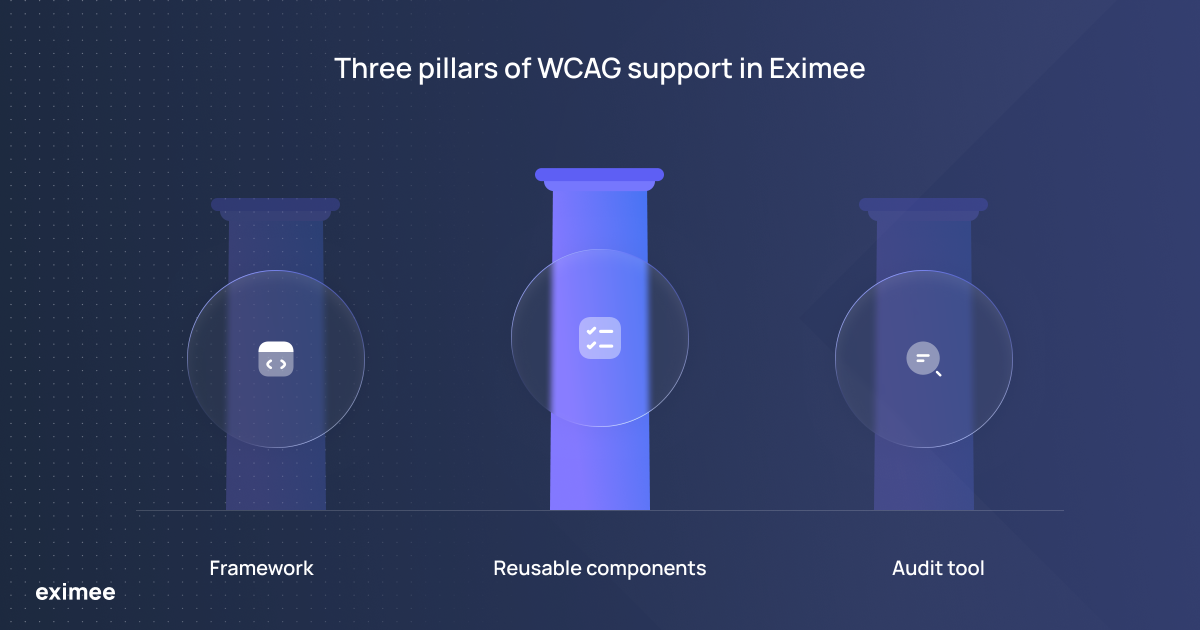
Three pillars of WCAG support in Eximee
The WCAG standard, while essential for ensuring digital accessibility, is often ambiguous and requires balancing compliance with the convenience of most users. Full implementation of its assumptions is generally neither possible nor necessary to create accessible and usable solutions. The key lies in consciously making compromises that combine accessibility with functionality and best UI/UX practices. The Eximee platform supports this process, enabling the design of WCAG-compliant interfaces without sacrificing practical usability.
Low-code technology, as the foundation of front-end standardization in banks, supports front-end security, accessibility across different channels, and regulatory compliance. Thanks to repeatable solutions implemented once, banks can more easily maintain compliance across the organization. While the advantages of low-code in banking—such as reduced time-to-market—are well known, Eximee stands out by also supporting the quality and accessibility of customer solutions. Project teams do not need to know all WCAG guidelines—it is enough to follow instructions and use ready-made components with accessibility knowledge already built in. This significantly simplifies work and accelerates the implementation of compliant processes.
Low-code technology is becoming a strategic support for banks in the area of digital accessibility. In the face of growing regulatory requirements, platforms such as Eximee demonstrate that it is possible to combine rapid implementation with high quality and WCAG compliance. Investing in accessibility standardization and automation is not only a step toward inclusivity but also a real regulatory and reputational advantage for financial institutions.