
Legal and regulatory changes often require banks to adjust their processes and technology much faster than typical implementation cycles in the financial sector. In these situations, flexible architecture and close cooperation between the bank and its technology provider become essential. A recent example of a similar challenge was the update of the application process for a nationwide child‑benefit program – commonly known as “Rodzina 800+” (“Family 800+”) – following the introduction of new legislation on September 12, 2025.


On February 1, 2026, a new annual cycle of the “Rodzina 800+” benefit began in Poland. This government program provides monthly financial support to families raising children, and one of the most common ways to apply is through online banking channels. The new legislation (referred to as UKR‑3) introduced additional requirements, including updated rules for processing applications submitted by foreign nationals. As a result, banks offering the application process had to ensure their digital channels were fully compliant and ready for the updated workflow.
The scope of work included updating the logic of two key processes: SW‑R (submitting a new application for the child benefit) and SW‑U (supplementing or updating data in an already submitted application). Both processes required new validation rules and adjustments aligned with UKR‑3. The major constraint was time: analysis, development, testing, and deployment all had to be completed within a single month, while ensuring full stability from day one of the new benefit cycle.
The Eximee Low‑Code Development Platform enabled the parallel rollout of the updated application process across seven banks. As part of the project, the process logic was updated, validation rules were adapted, and all changes were integrated with the banks’ internal systems and the national social insurance institution (ZUS).
This allowed customers to submit applications for the new benefit period directly through their familiar online banking environment.
From the decision stage to production launch, the entire cycle took less than a month after the publication of the regulatory changes. The work included coordinating seven simultaneous deployments, conducting acceptance tests, and verifying compliance with the new legal requirements. Special attention was given to data quality and handling exceptions introduced by the updated regulations.
Within the first week of the new process going live, customers submitted 426,000 applications through banking channels, covering benefits for approximately 630,000 children. Banks using the solution delivered by Consdata accounted for roughly 50% of the online‑banking market. Among the seven banks involved, five had previously offered the 800+ application process, while two launched it for the first time as part of this project.
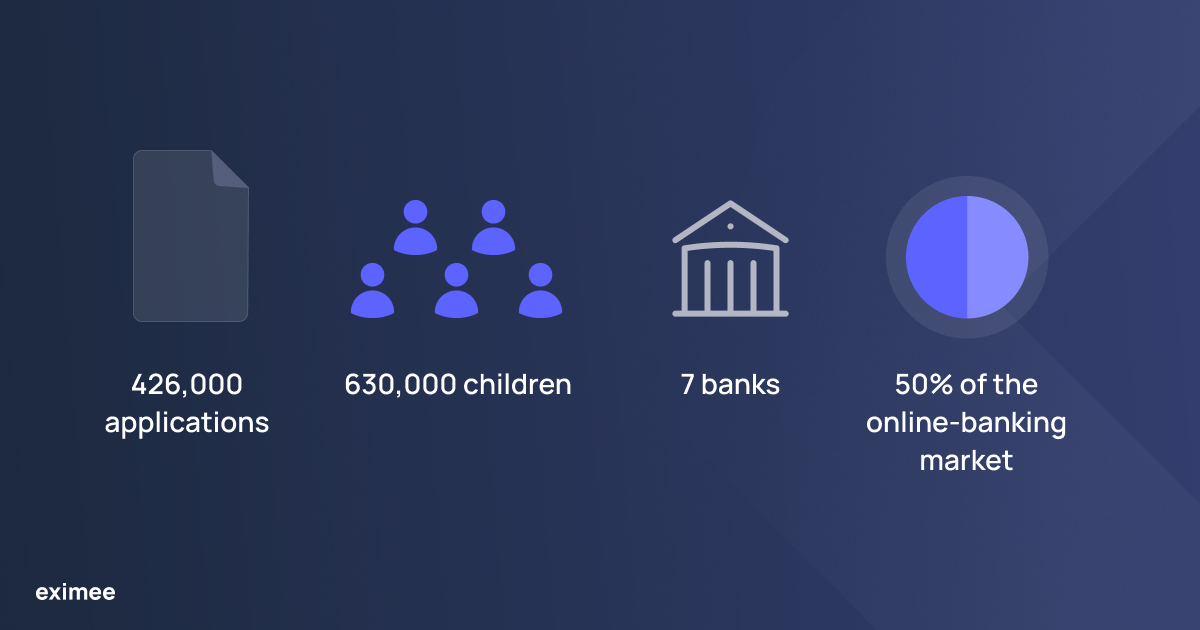
Statistics from the first week after the launch of the updated “800+” child‑benefit application process.
The system has remained stable despite the high traffic volume. The key factors behind the project’s success included rapid iteration, centralized monitoring, and close collaboration with the banks. These elements made it possible to deliver the required changes significantly faster than typical projects completed for the financial sector.
This implementation demonstrates the importance of fast adaptation to regulatory changes and the value of a centralized platform for handling large‑scale public‑service processes. Banks have received ready‑to‑use, compliant workflows, and customers can benefit from a simple, fast, and familiar way to submit their applications.
Make an appointment for a discovery meeting and find out how we can help you.


 Eximee Team
 Michał Stolarski
 Tomasz Ampuła
 Eximee Team
 Eximee Team
 Eximee Team